Work-for-Hire vs Co-Development vs Outsourcing: Choose the Contract, Not the Label
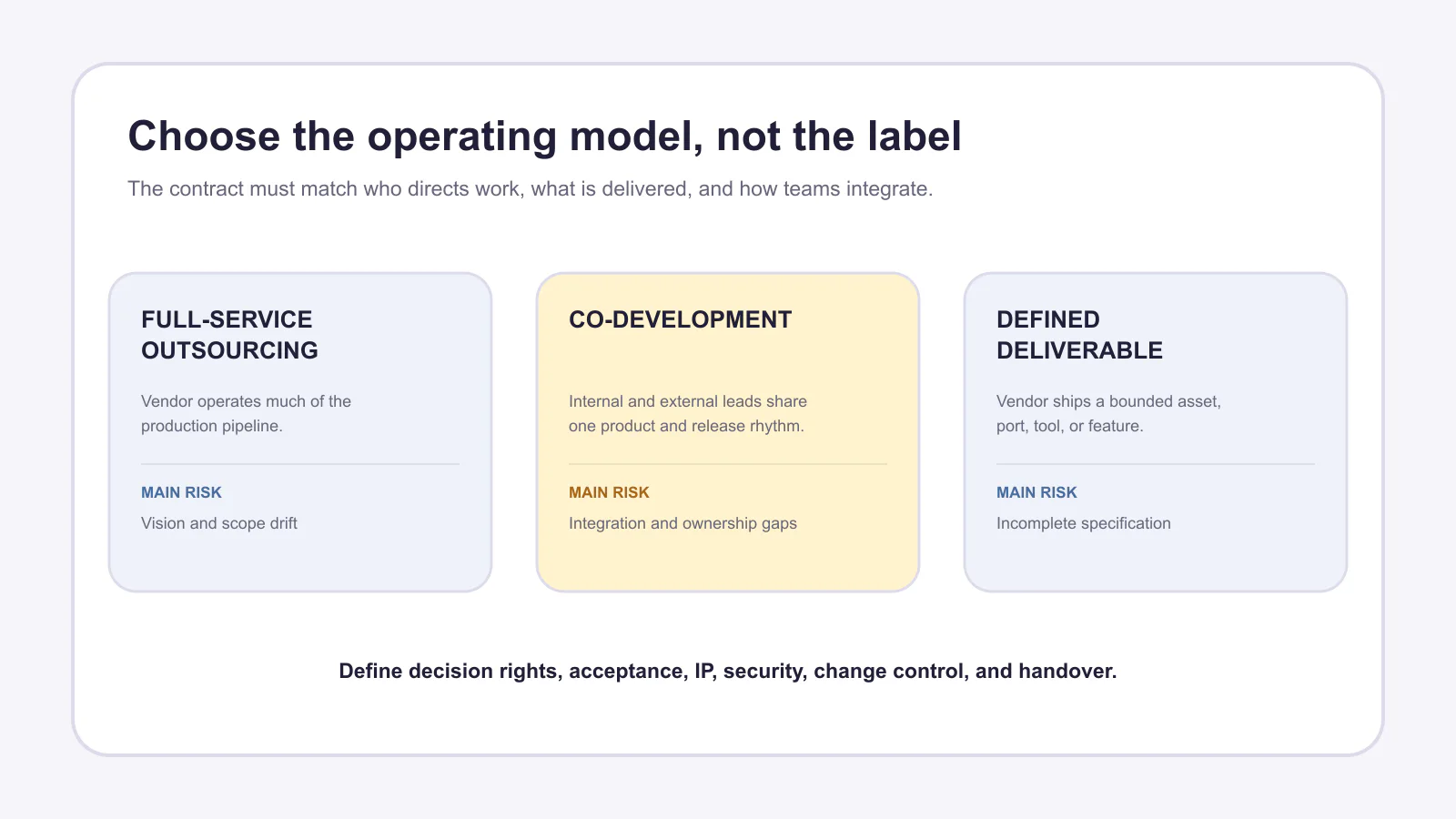
Image: Muudd
“We need an external studio” can describe three radically different deals: a team owning a production stream, specialists joining your internal team, or a vendor delivering a tightly specified package.
The names vary across studios. The contract is what counts.
Three common structures
| Structure | Who directs daily work? | What is purchased? | Main operating risk |
|---|---|---|---|
| Full-service outsourcing | Vendor within agreed governance | A game, major feature set, or production phase | Vision and scope drift |
| Co-development | Shared between internal and external leads | Capacity or capability integrated with your team | Integration and ownership gaps |
| Defined-deliverable engagement | Client specifies outcomes and acceptance | Assets, ports, tools, levels, or a bounded feature | An incomplete specification |
These are commercial descriptions, not universal legal definitions.
Full-service outsourcing
Use this structure when you need a vendor to assemble and operate much of the production pipeline. You still need an accountable product owner on your side. Outsourcing execution does not outsource the business decision about what should ship.
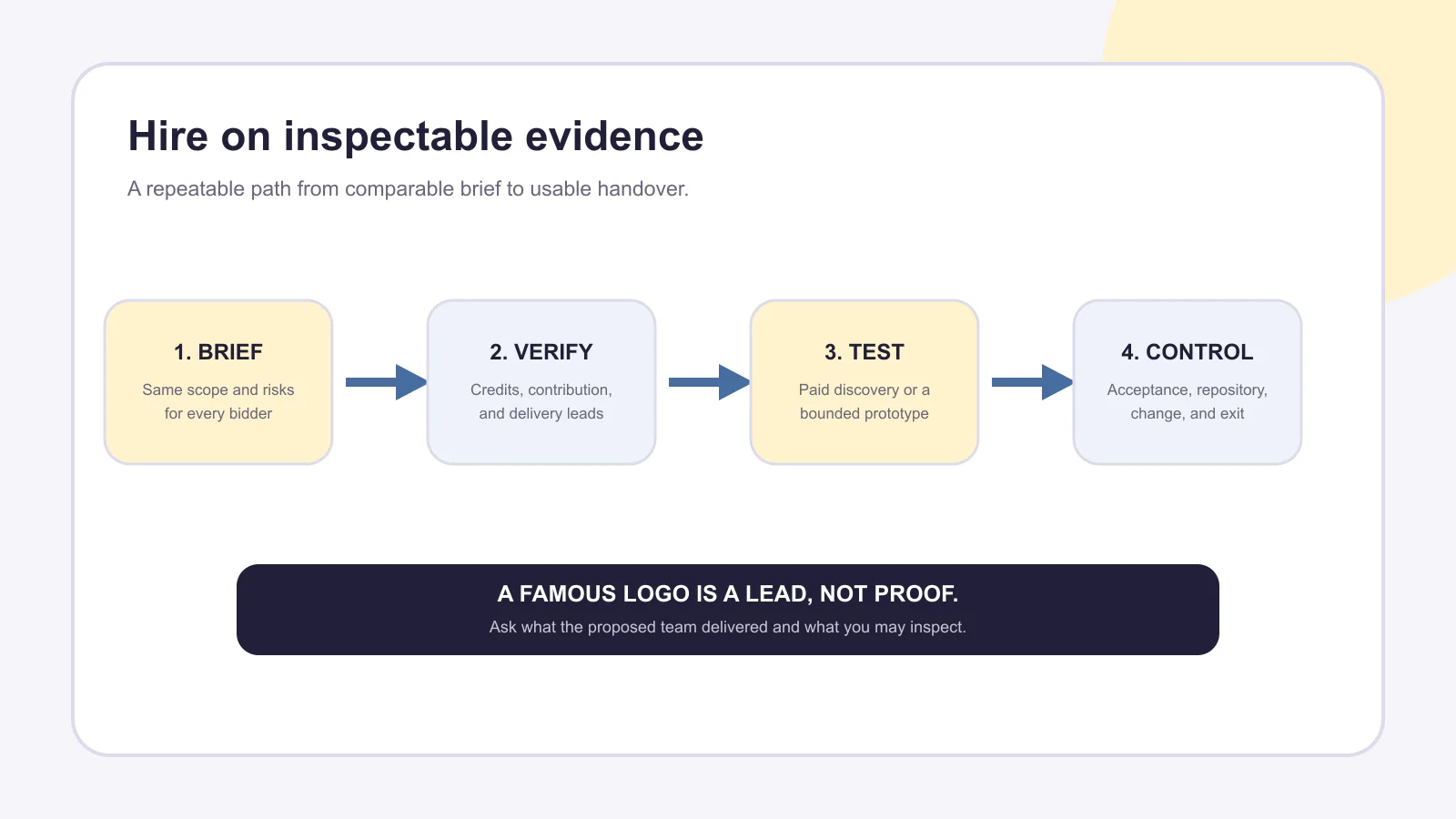
The statement of work should identify:
- deliverables and excluded work;
- platforms, performance targets, and content assumptions;
- milestone evidence and acceptance procedure;
- repository and build access;
- dependency, licence, security, and privacy obligations;
- change-control pricing;
- handover and termination assistance.
Co-development
Co-development is powerful when you already have a team and need another team to work in the same product, backlog, or release train. It is also the model most likely to fail quietly: two competent groups can still duplicate work, block each other, or assume the other owns a system.
Define module ownership, code-review authority, branch and release rules, incident response, communication overlap, and who makes the final design call. “We collaborate in Slack” is not governance.
Defined deliverables
A bounded engagement works best when you can describe what “accepted” means. An environment pack, console port, localization pass, accessibility audit, or self-contained tool can be inspected more cleanly than “make the game fun.”
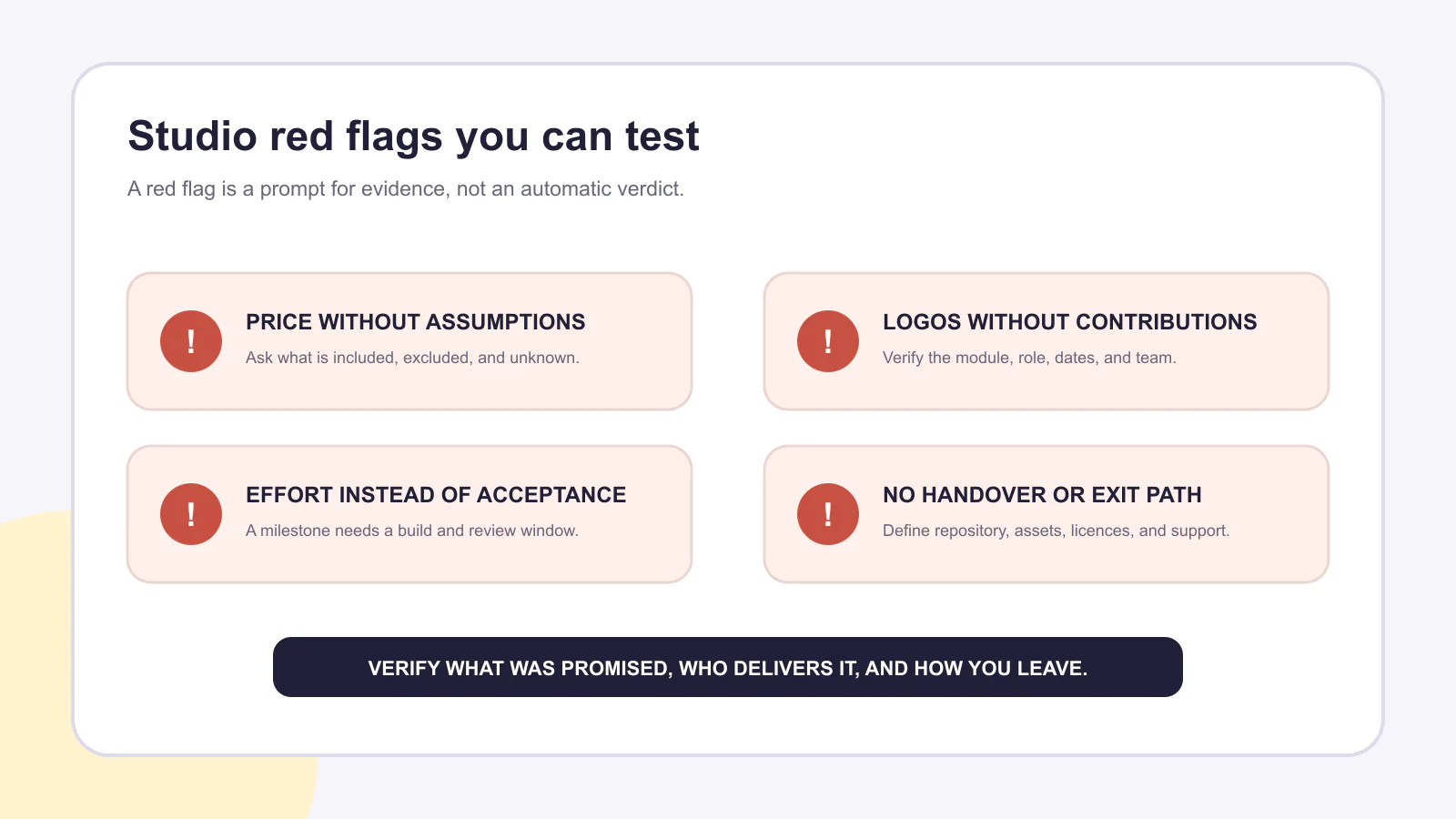
Do not confuse a fixed price with a fixed reality. If the inputs, platforms, or dependencies change, the contract needs an orderly change process rather than a battle over who guessed wrong.
“Work made for hire” needs legal care
In the United States, calling a contract “work for hire” does not automatically make every contractor-created work a statutory work made for hire. The U.S. Copyright Office explains that employee work within the scope of employment is one route; commissioned work requires a signed agreement and must fit a statutory category.
Video games combine code, visual art, music, writing, trademarks, data, and third-party licences. Use qualified counsel for the relevant jurisdictions and obtain express assignments or licences where needed. WIPO’s game-development guidance emphasizes that contracts determine ownership and exploitation rights.
A studio is not a shortcut around worker rules
Hiring individual contractors instead of a studio can change tax and employment obligations. In the United States, the IRS says classification depends on behavioral control, financial control, and the parties’ relationship - not merely what the agreement calls someone. Other countries use their own tests.
Our decision rule
- No internal production engine: consider full-service outsourcing, but keep one empowered owner on your side.
- A functioning core team with a capacity gap: consider co-development.
- A measurable package with stable inputs: consider a defined-deliverable engagement.
- One persistent seat under your direction: consider employment or specialist hiring, with classification advice.
The provocative truth is simple: the engagement model does not save a vague project. It only decides where the vagueness explodes.
Sources
- WIPO: video-game business and legal guidance
- WIPO: game-development IP resources
- U.S. Copyright Office: Works Made for Hire, Circular 30
- IRS: worker classification
- NIST: Secure Software Development Framework
Source check: 27 July 2026.
work for hireco-developmentgame outsourcinggame production modelshire game studio