How to Hire a Game Development Studio: A Practical 2026 Guide
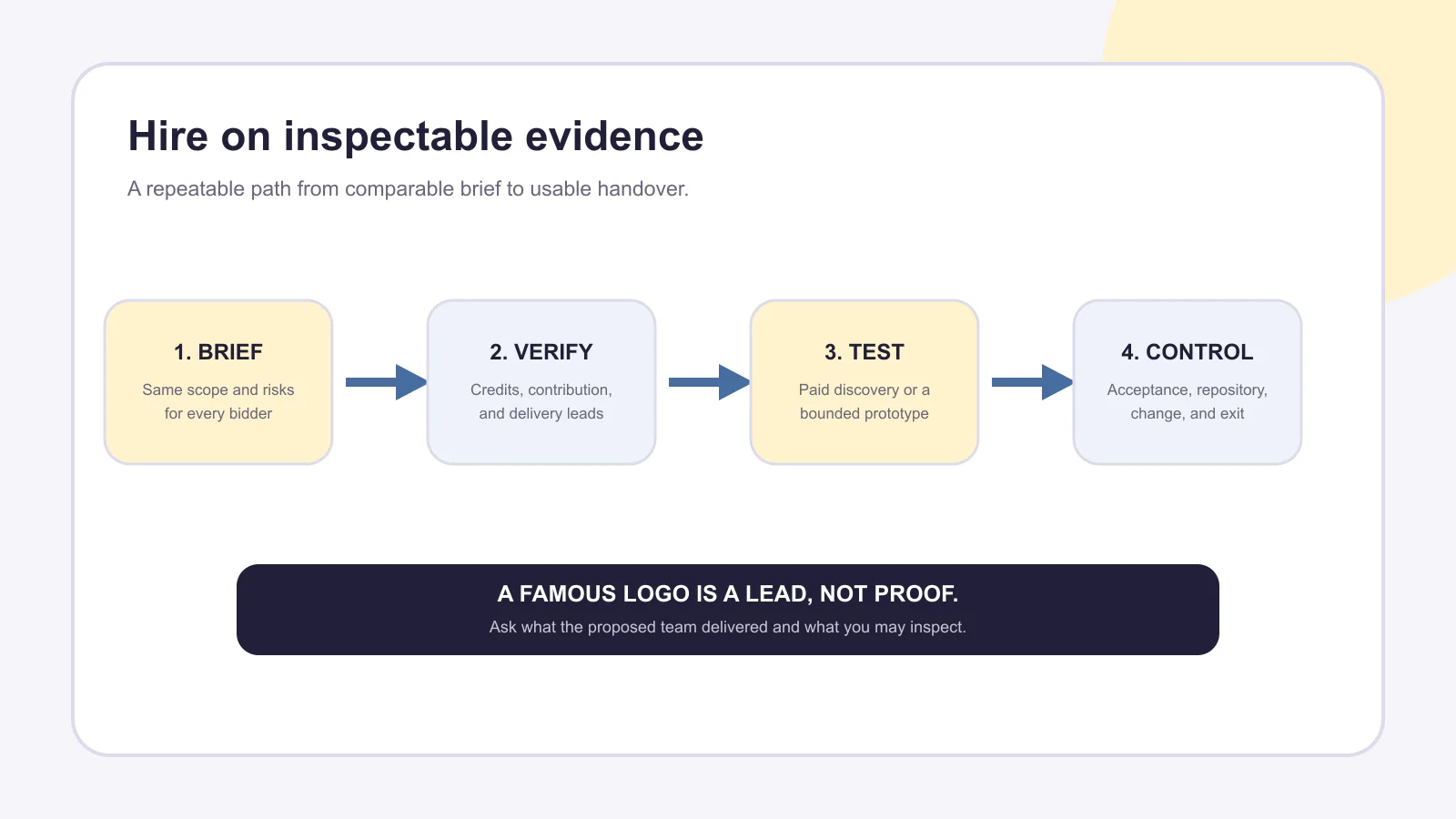
Image: Muudd
Hiring a game studio should not feel like gambling. If it does, the process is missing evidence.
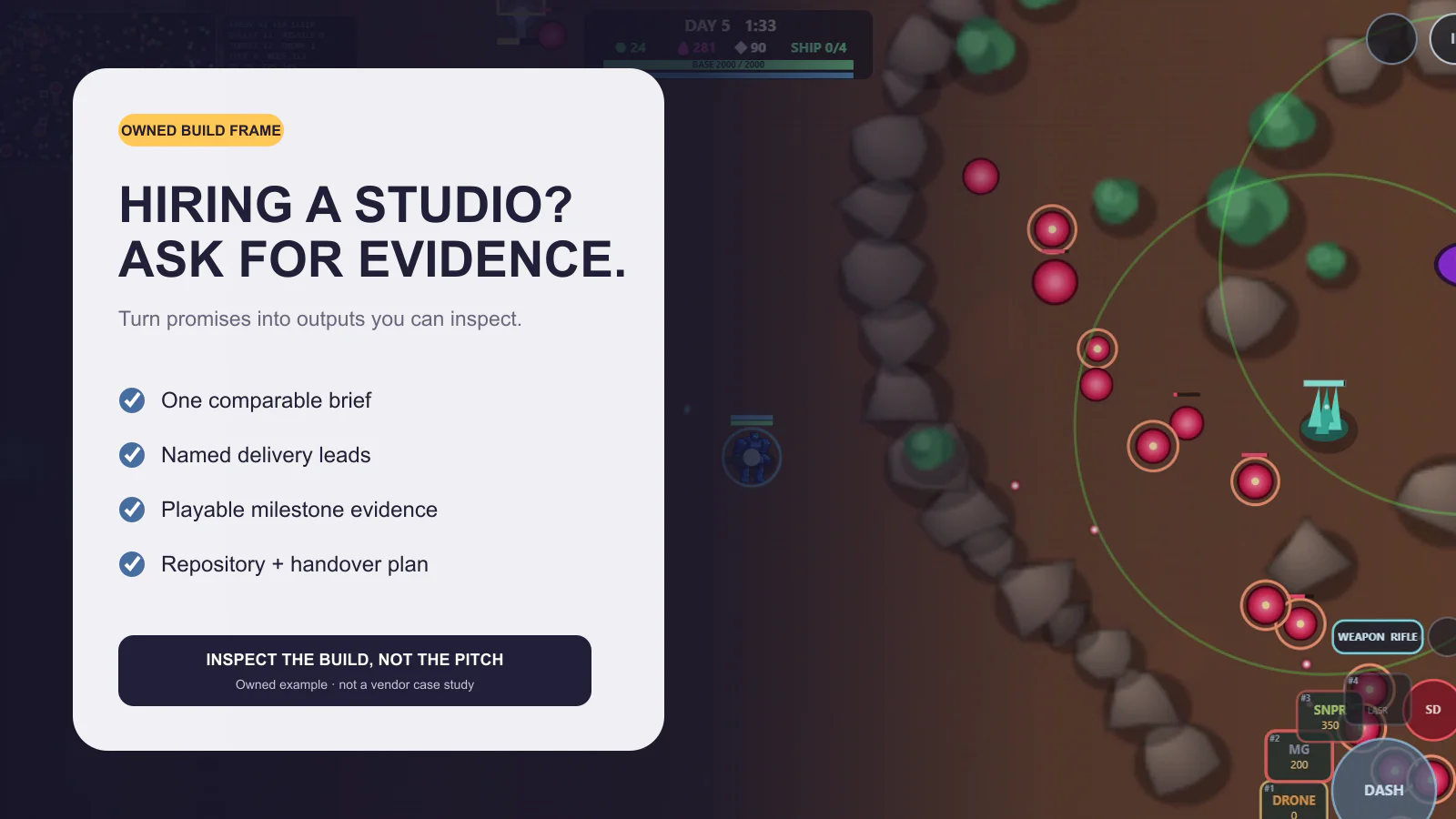
The cure is not a longer pitch deck. It is a comparable brief, verifiable credits, contact with the real delivery leads, and a contract that turns promises into inspectable outputs.
1. Write the brief studios can price
Give every bidder the same baseline:
- player promise and core loop;
- target platforms and launch territories;
- online, account, payment, moderation, and backend needs;
- target art direction and content volume;
- accessibility and localization expectations;
- performance targets and reference hardware;
- current prototypes, code, assets, and documentation;
- budget boundary and decision dates;
- what the client will supply;
- known unknowns.
If two studios are pricing different games, comparing totals is meaningless.
2. Build a shortlist from credited work
Look for evidence adjacent to your actual risk. A shipped console port matters for console certification. A live multiplayer title matters for network operations. Beautiful art does not prove backend capability.
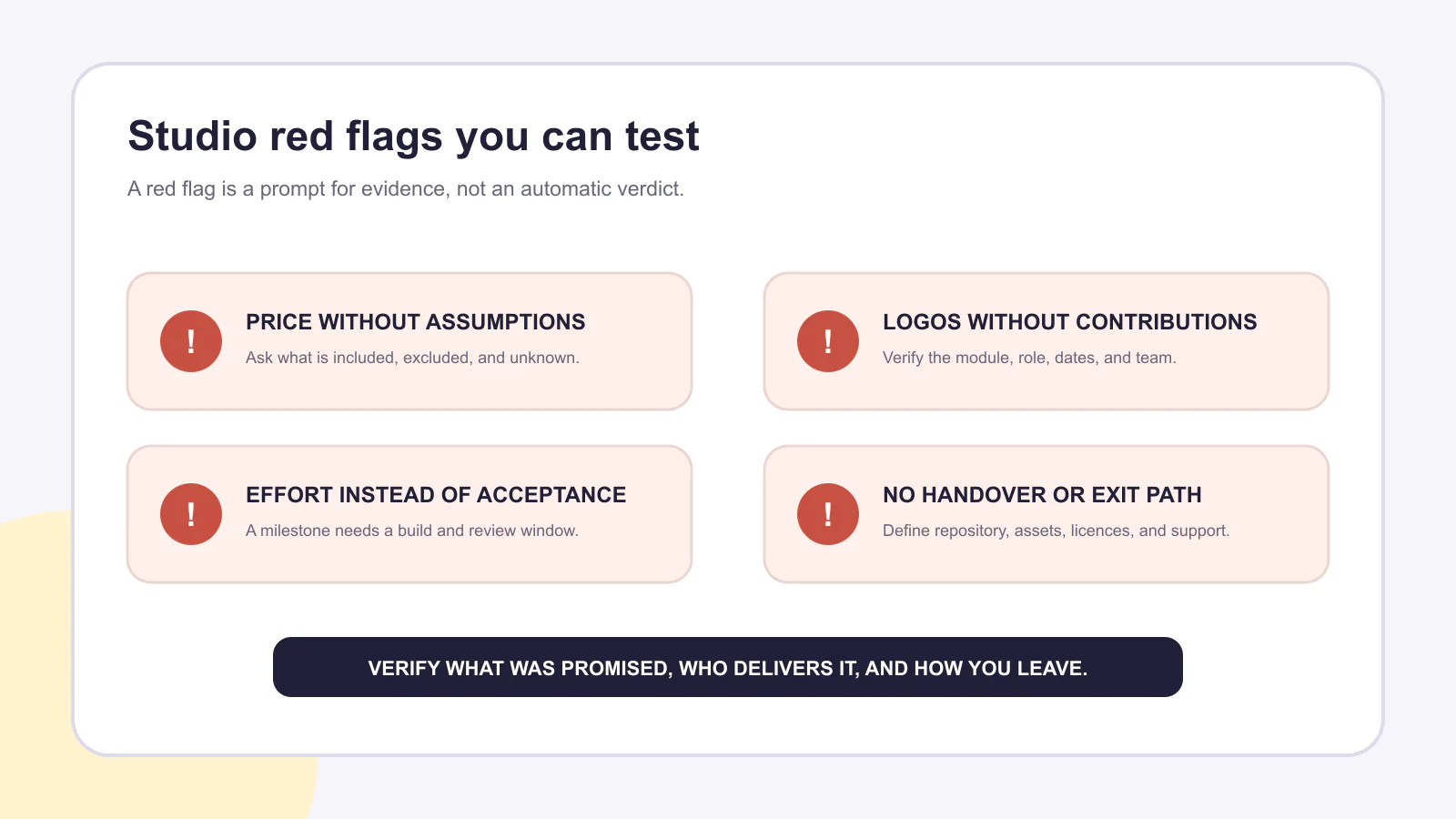
For every portfolio title, ask what the studio delivered and which proposed team members did the work. Confirm credits or references where confidentiality permits. A famous logo without a defined contribution is a lead, not proof.
3. Meet the delivery team
The producer, technical lead, art lead, and other critical owners should join the evaluation before signature. Discuss one real project risk and ask how they would investigate it.
You are testing whether the team can expose uncertainty - not whether it can say yes enthusiastically.
4. Pay for uncertainty to be reduced
When the largest risks are still unknown, commission a bounded discovery, prototype, technical spike, or content test. Define what it must answer and what files you receive.
A trial is not mandatory in every procurement. Platform access, confidentiality, timing, and setup costs can make one impractical. But committing to a large production while refusing any smaller evidence-gathering step demands a very strong alternative.
5. Compare normalized proposals
Put proposals into the same table:
| Question | Bid A | Bid B | Bid C |
|---|---|---|---|
| Scope and exclusions | |||
| Named team and allocation | |||
| Milestone evidence | |||
| Client dependencies | |||
| Third-party costs | |||
| IP and licence treatment | |||
| Security and data obligations | |||
| Handover and termination |
The lowest price can be the best bid. It can also be the bid that excluded QA, backend hosting, source assets, or certification support. Normalize first.
6. Contract for the ugly months
Good contracts matter most when a milestone slips or priorities change. Address:
- statement of work and acceptance;
- payment triggers and disputed work;
- change control;
- staffing and substitutions;
- IP assignments, pre-existing tools, and third-party materials;
- open-source and generative-AI policy;
- security, privacy, incident notice, and access;
- warranties, indemnities, liability, and insurance;
- termination, transition, and repository handover.
WIPO’s game-industry guidance illustrates why development milestones and IP terms need specificity. The U.S. Copyright Office also makes clear that “work made for hire” has defined legal requirements. Use qualified counsel rather than copying a template.
7. Operate with visible evidence
Maintain client-controlled access to the repository, issue tracker, build distribution, and critical service accounts. Review working builds at an agreed cadence. Track decisions and changes.
The goal is not to micromanage. It is to prevent a project from becoming a monthly invoice attached to a private story.
Sources
- WIPO: video-game business and legal guidance
- WIPO: Mastering the Game
- U.S. Copyright Office: Works Made for Hire
- NIST SP 1326: supplier due diligence
- NIST: Secure Software Development Framework
Source check: 27 July 2026.
hire game studiogame development outsourcingwork for hireco-developmentgame production