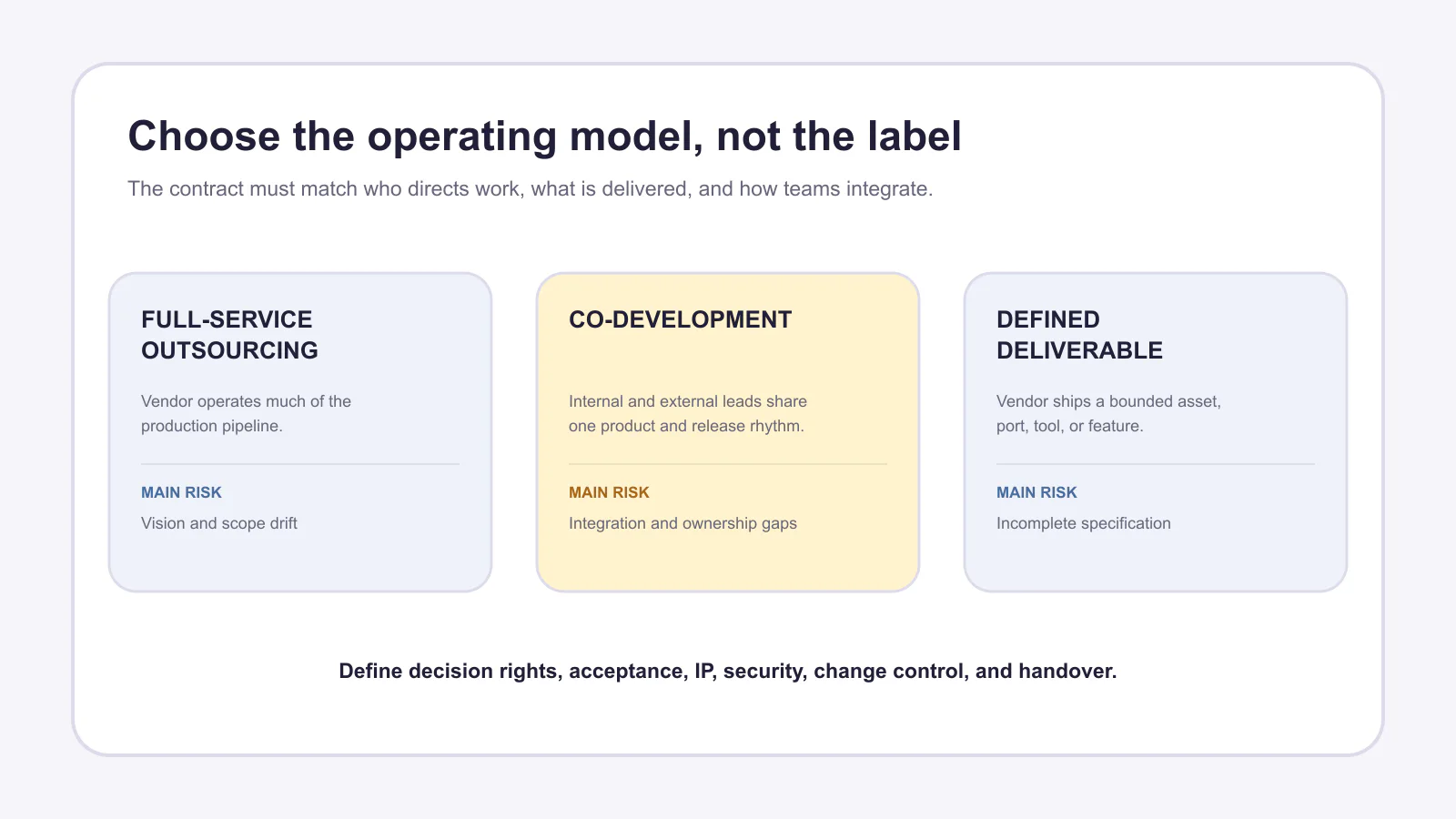
Red Flags When Choosing a Game Development Studio
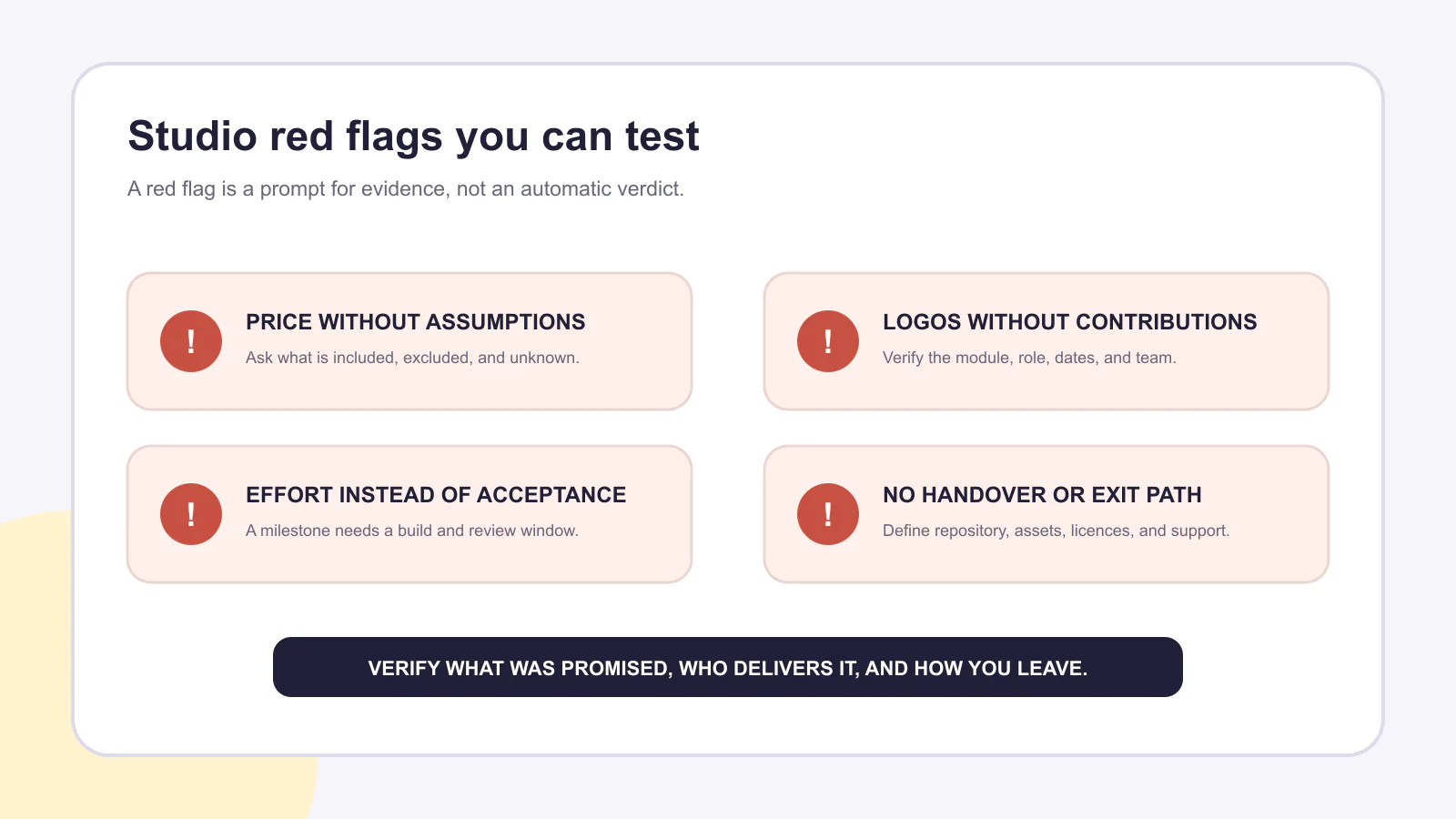
Image: Muudd
Nobody hires a disaster. They hire a persuasive pitch and discover the delivery team later.
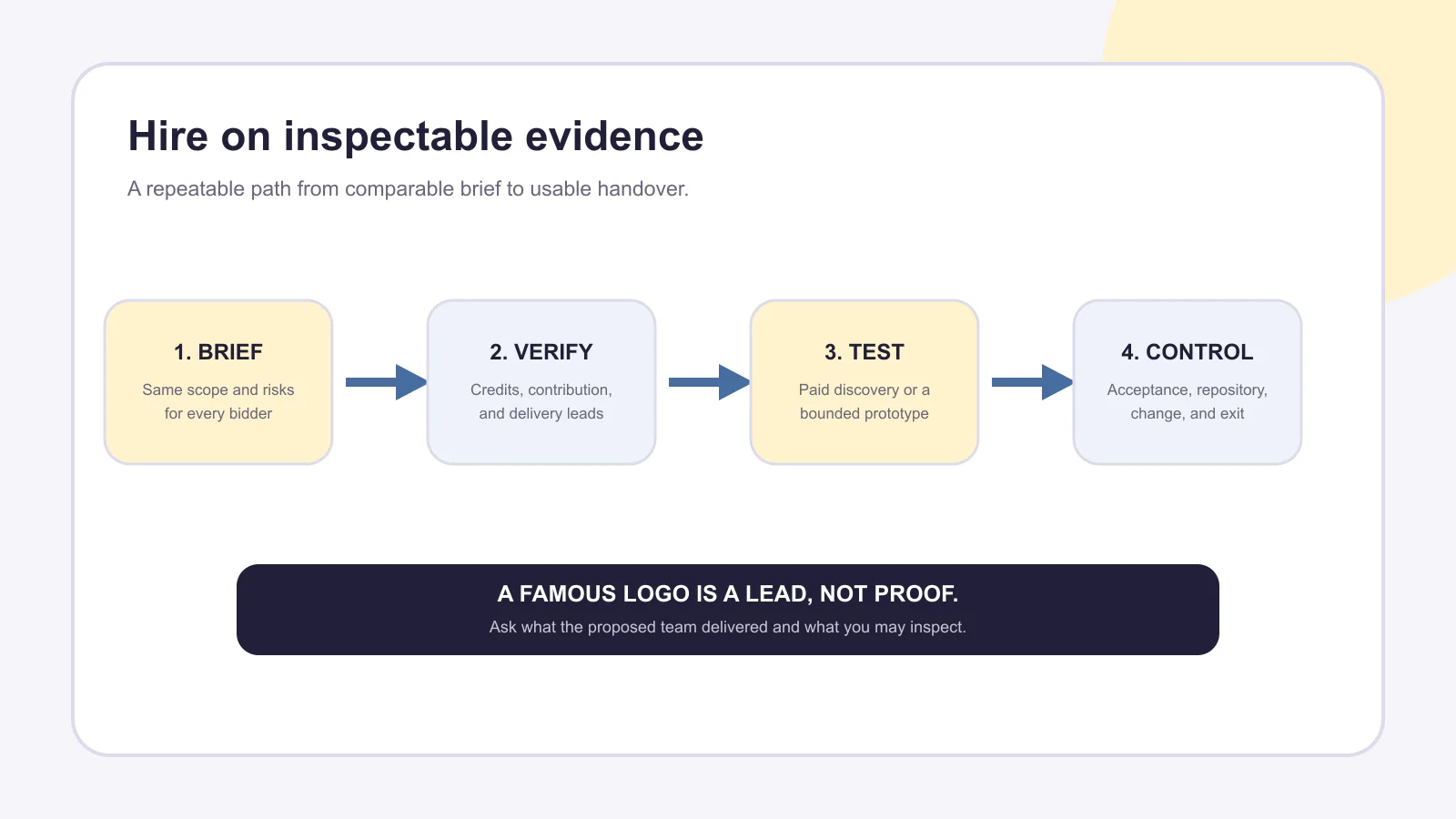
That is why the most important question is not “Did I like the call?” It is “Can I verify what was promised, who will do it, and how I leave if it stops working?”
Red flag 1: a price with no assumptions
An early range can be useful. A firm number before the studio understands platforms, online features, content volume, art fidelity, certification, accessibility, localization, and live operations is not a plan.
Ask for the assumptions behind the estimate. If they cannot show what is included, excluded, client-supplied, and still unknown, the quote is theatre.
Red flag 2: famous logos without contribution detail
A portfolio can truthfully name a major game while hiding that the vendor supplied a narrow asset set. That contribution may still be excellent - it is simply not evidence that the studio can own your whole production.
Request:
- the exact module, asset class, platform, or phase delivered;
- the dates and commercial entity responsible;
- names and roles of people proposed for your team;
- permission to contact a relevant client reference;
- a build, sample, or case study you may legally inspect.
Vague credits are not proof of fraud. They are proof that verification is incomplete.
Red flag 3: the delivery team is invisible
Meet the producer and discipline leads who would actually run the project. Ask whether named people are committed, when they start, and what substitution rights the vendor has.
A polished business-development team cannot compensate for a production team you never evaluated.
Red flag 4: milestones describe effort, not evidence
“Four weeks of development” is not an acceptance criterion. A milestone should identify the build, assets, tests, documentation, supported hardware, known defects, and review window.
WIPO’s sample game-development milestone schedule includes concrete stages such as prototype, vertical slice, alpha, beta, localization, QA candidate, final master, and archive/handover. Your project may use different stages, but each one still needs a defined delivery.
Red flag 5: IP language is a slogan
“You own everything” leaves unanswered:
- when ownership transfers;
- which pre-existing vendor tools remain vendor-owned;
- which third-party licences apply;
- whether music, fonts, plugins, datasets, and stock assets can ship commercially;
- how open-source obligations are recorded;
- whether generative-AI tools or outputs are permitted;
- who can create sequels, ports, merchandise, and marketing assets.
The U.S. Copyright Office warns that commissioned work is not automatically a statutory work made for hire. Get jurisdiction-specific legal review and precise assignments or licences.
Red flag 6: no security or provenance story
For a connected game or any build touching user data, ask how the studio controls repository access, secrets, dependencies, vulnerabilities, incident reporting, and offboarding. NIST’s supplier due-diligence guidance highlights provenance, resilience, foundational cyber practices, ownership/control, and supply-chain tiers.
“We use GitHub” is not a security program.
Red flag 7: exit means starting over
The agreement should cover repository access, source and editable assets, build instructions, credentials transfer, documentation, third-party accounts, final invoices, and a defined transition period. If the vendor is the only party able to build the game, you do not own an exit - you own a dependency.
What is a yellow flag, not an automatic rejection
- A studio declines an unpaid test.
- A small team lacks a title in your exact genre.
- A reference is limited by confidentiality.
- The team is overseas.
- A quote is materially lower than another.
Each needs explanation and evidence. None proves bad intent on its own. If uncertainty remains, a small paid discovery or technical spike can test the working relationship without pretending to be a miniature version of the full project.
Sources
- WIPO: Mastering the Game, including milestone and contract guidance
- U.S. Copyright Office: Works Made for Hire
- NIST SP 1326: supplier due-diligence assessment
- NIST: Secure Software Development Framework
Source check: 27 July 2026.
game studio red flagshire game studiogame outsourcingvetting studiosgame production