Cost to Make a Game in 2026: Build a Budget You Can Defend
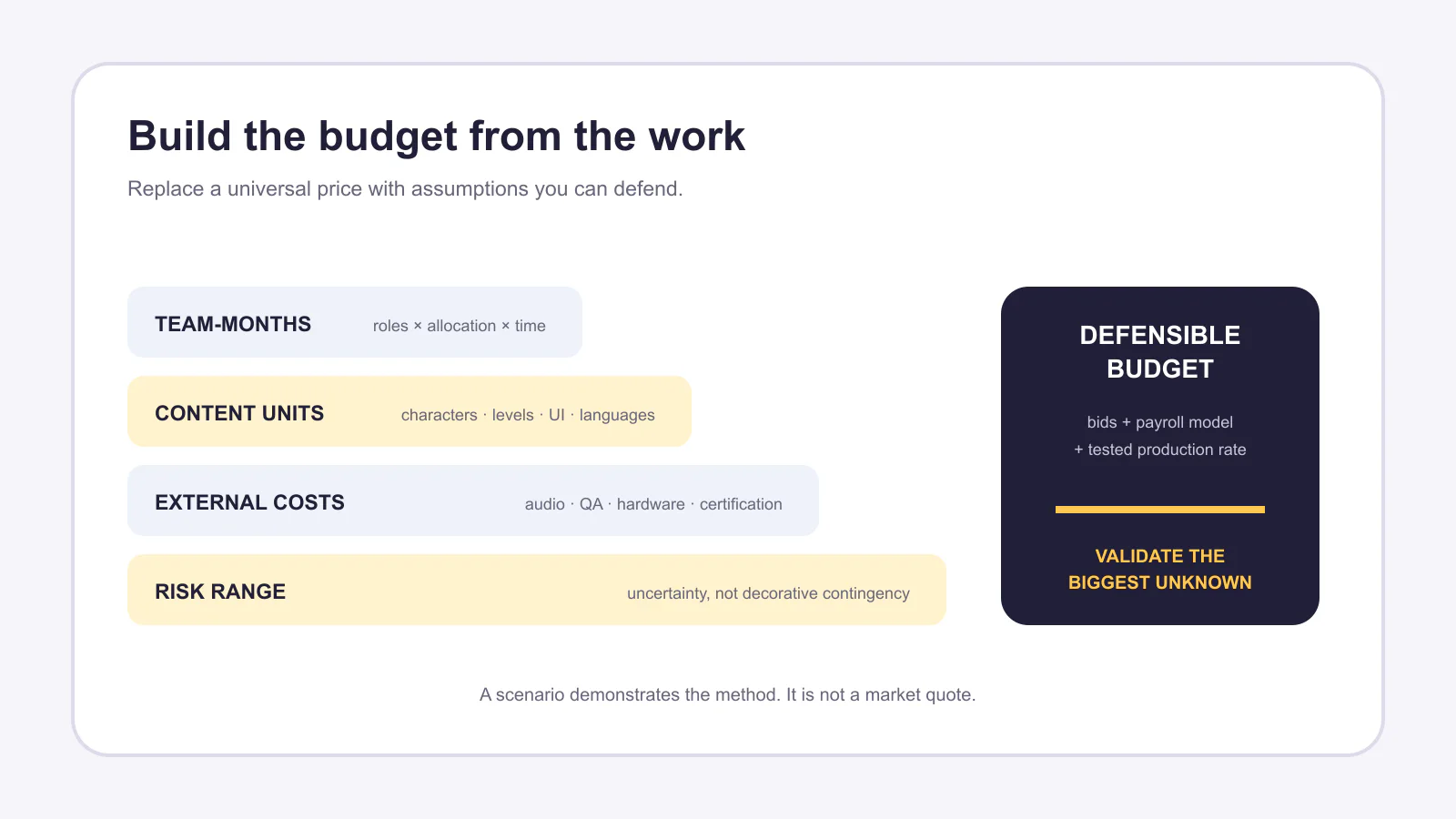
Image: Muudd
Anyone who gives you “the cost of a game” before defining the game is selling confidence, not an estimate.
The defensible number comes from a bottom-up model: team capacity, production time, content volume, pass-through costs, and risk. Engine choice can matter, especially through licence terms and specialist availability, but it rarely rescues an uncontrolled scope.
Start with the cost equation
Use:
Production labor + external services + licences and infrastructure + hardware and certification + launch support + contingency
For a studio proposal, production labor may already include management, benefits, equipment, and margin. Ask what the rate contains before adding those items again.
Build a team-month plan
For each phase, list the roles and allocation:
| Phase | Typical questions |
|---|---|
| Discovery | What must be proven before production? |
| Pre-production | Is the pipeline, architecture, art target, and content plan viable? |
| Production | How many features and content units can the team complete? |
| Alpha/beta | What remains besides bug fixing - content, optimization, compliance, localization? |
| Launch/post-launch | Who handles submission, incidents, patches, analytics, and support? |
“Six developers for a year” is still too vague. A senior network engineer, animator, producer, QA analyst, and technical artist have different roles and may not be needed at the same intensity every month.
Count content in units
Feature lists hide volume. Count:
- characters, animation sets, skins, and weapons;
- environments, rooms, props, and lighting passes;
- missions, encounters, dialogue lines, and cinematics;
- UI screens and states;
- platforms, languages, control schemes, and accessibility modes;
- online services, moderation flows, and live events.
Then sample the expensive units. One polished enemy or environment slice can expose more truth than a spreadsheet of hopeful averages.
An illustrative scenario - not a market quote
Suppose a hypothetical prototype uses four full-time-equivalent people for six months. If the assumed blended, fully loaded studio rate is $12,000 per person-month:
- Labor: 4 × 6 × $12,000 = $288,000
- Assumed external audio, testing, and hardware: $30,000
- Subtotal: $318,000
- Illustrative 20% risk reserve: $63,600
- Scenario total: $381,600
Every number above is an assumption created to demonstrate the method. It is not a claim that $12,000 is a typical 2026 rate or that 20% is universally sufficient. Replace each input with a bid, payroll model, or tested production rate.
The costs most often separated from “development”
- platform accounts, hardware, certification, and resubmission;
- cloud hosting, observability, customer support, and fraud controls;
- QA devices, compatibility, localization, and ratings;
- music, voice, fonts, middleware, stock content, and licence renewals;
- legal, privacy, tax, insurance, and accounting;
- marketing creative, community, paid acquisition, and public relations;
- patches, live operations, refunds, and incident response;
- handover, documentation, and vendor transition.
Ask each vendor to mark these as included, excluded, client-supplied, or unknown.
Range the risks instead of hiding them
Build low, base, and high cases for:
- feature count;
- content throughput;
- platform count;
- online concurrency and service complexity;
- revision rounds;
- certification passes;
- launch support duration.
Do not spread an arbitrary percentage evenly across the budget. Put uncertainty where it lives. A known audio quote needs less reserve than unproven multiplayer architecture.
The smartest first spend
Spend early money on the question that can kill the project: fun, technical performance, content throughput, platform feasibility, or market response. Define the evidence the prototype must produce and the decision it will unlock.
The least expensive feature is the one you reject before the pipeline scales around it.
Sources
- WIPO: Mastering the Game, including development milestones
- WIPO: game-development IP and business resources
- NIST: Secure Software Development Framework
- U.S. Copyright Office: Works Made for Hire
Source check: 27 July 2026.
game development costgame budget 2026outsourcing ratesindie game costgame production budget